Challenges
As a product manager or designer of a jewelry brand, have you ever faced feedback from manufacturers like:
- “This design is too challenging to produce.”
- “This design exceeds the budget.”
- “This concept may pose quality risks in mass production.”
- “The material selection isn’t suitable for this design.”
- “The production timeline might be longer than expected.”
These challenges may require you to rethink your approach, make compromises, or even delay your launch schedule. Although this can be frustrating, gaining a solid understanding of stainless steel jewelry’s technical possibilities and limitations is essential. With a strong knowledge of manufacturing techniques, you can create designs that are both innovative and practical. In this article, we share useful tips and insights to help you design smarter and avoid common pitfalls.
Stainless Steel Material Properties
Stainless steel is an excellent material for jewelry due to its durability, safety, and aesthetic qualities.
- Durable and Corrosion-Resistant: Stainless steel is resistant to bending, scratches, breakage and corrosion. Unlike silver, it won’t tarnish or turn black. It’s also hypoallergenic compared to copper or alloy jewelry, which may cause allergies or contain toxic lead.
- Consistent Material Inside and Out: The material is uniform throughout, ensuring no discoloration, fading, deformation, or skin irritation.
- Acid and Alkali Resistant: Stainless steel withstands acidic and alkaline environments without damage.
- Hypoallergenic and Safe: It’s safe for most skin types, avoiding common allergic reactions caused by other metals.
Metal Crafting Techniques
1. Laser Cutting
- Utilizes advanced CNC laser machines to cut stainless steel sheets into precise shapes.
- The laser beam heats and melts the steel, allowing for intricate, custom designs.
- Requires expert software design and careful material layout to minimize waste.
- After cutting, parts undergo pre-polishing to remove burrs and fine polishing for a smooth surface.


2. Etching
If laser cutting feels too plain, additional techniques like etching can enhance the design. This involves coating the steel with a protective layer, marking patterns using laser engraving to expose the steel, and submerging it in strong acid to create textured designs.
- Etching creates patterns and textures on stainless steel by immersing it in an acidic solution. The results can range from coarse textures to intricate, refined designs.
- It allows for diverse patterns, such as floral motifs, geometric lines, and custom text, adding visual interest. Precision and consistency in the pattern are crucial for achieving a detailed and polished outcome. Overly complex or irregular designs may not transfer well during etching.
- The timing of acid exposure is critical—too long can cause overcorrosion and affect the outcome.


Below Halloween set combines etching and enamel techniques.

3. Casting
- Casting melts stainless steel at 2000°C, pours it into wax molds, and cools it into the desired shape, requiring precise temperature control to avoid cracks.
- It’s perfect for detailed, 3D designs with intricate features.
- The process starts with wax prototypes, followed by reusable silicone molds. Hand-carving can add extra detail.
- After casting, products are demolded and refined, but defects are common, often requiring multiple trials and extending production time.


Etching creates fine details but isn’t suited for large pieces, while casting handles larger designs but lacks detail. Combining them balances their strengths—etched patterns can enhance cast pieces, or casting can serve as a base for etching. Precision is key to quality results.
4. Oil Pressing
Oil pressing (hydraulic pressing) expands creative possibilities in stainless steel jewelry design. Ideal for shaping intricate curves, small components, or adding embossed and textured effects like leaf veins.
- Steel molds are installed on press machines, which apply 100–300 tons of pressure to shape steel sheets into intricate designs, achieving finer details than casting.
- Mold quality and machine tonnage directly affect the outcome. Mold is made of steel, requiring precise machining and polishing to ensure smooth shaping and easy release.
- Selecting the right press is vital—too little pressure won’t shape the piece, while too much can cause deformation. The press’s maximum pressure should match the product design.


Etching, casting, and oil pressing work great together with other techniques to create unique designs. For example, you can laser-cut a pattern first, then use oil pressing to shape it. Or, start with oil pressing for the base and add etched details later. Mixing these methods helps bring out the best of each to make more creative and detailed jewelry.
5. Polishing
- All raw metal pieces after cutting, oil pressing, or casting start rough and must be polished for shine.
- The polishing process involves multiple steps. It begins with machine grinding, which includes rough and fine polishing stages. Rough polishing removes visible burrs and scratches to create a smooth base, while fine polishing eliminates minor imperfections and enhances the surface’s shine. Consistent and even polishing is crucial for all areas.
- Polishing quality is crucial for the final appearance and plating adhesion.
- Skilled technicians play a key role in polishing by understanding the strengths of various tools to achieve the best effects.


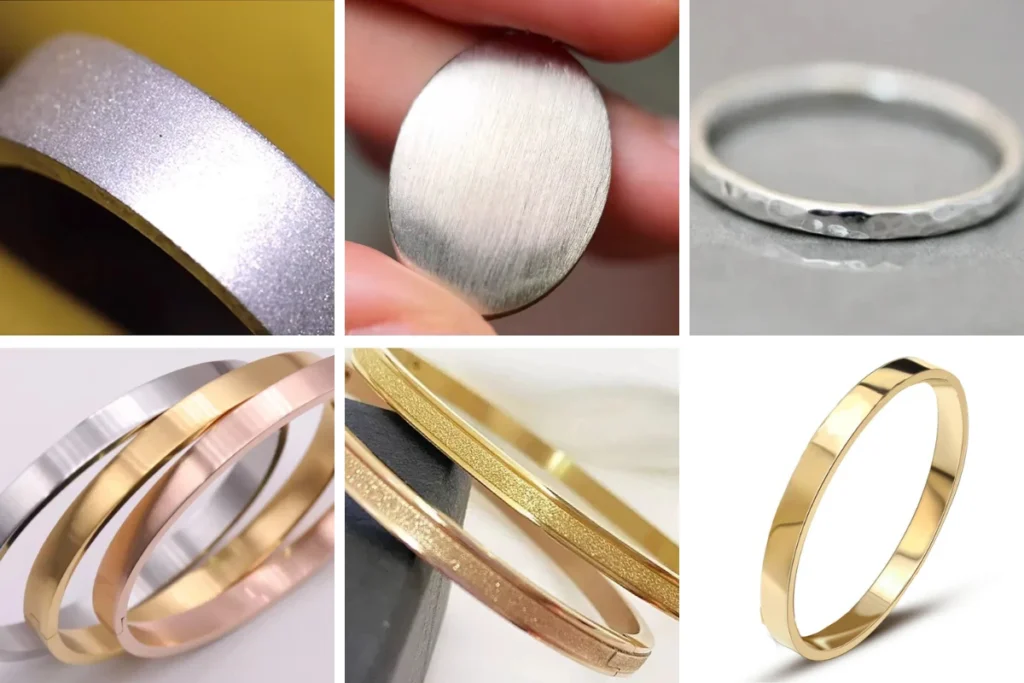
5.1.Other surface finishes
In addition to mirror polishing, various finishes like matte, sandblasted, brushed, and hammered are also popular. These textures can be achieved after rough polishing or by using specific tools to create the desired effect.


6. Plasma Treatment (New Technology)
- Plasma nitriding forms a hard, corrosion-resistant nitride layer on steel.
- Improves wear resistance and surface hardness.
- Enhances oxidation protection and product durability.
PVD Plating Technique
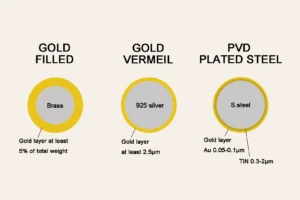
- PVD (Physical Vapor Deposition) Plating is the most durable and stable plating method. In a vacuum environment, metal is vaporized and deposited onto the surface of stainless steel jewelry, forming a thin metallic coating. It also improves wear and corrosion resistance.
- The plating includes a titanium base layer about 0.7 microns thick, topped with a fine layer of genuine gold, about 0.05 microns thick.
- Traditional electroplating uses chemical reactions to deposit metal layers but fades quickly and contains nickel, causing allergies. PVD plating, using a vacuum, creates durable, uniform, hypoallergenic layers, perfect for stainless steel.
- Proper polishing ensures smooth plating. Before PVD, ultrasonic cleaning removes dirt. During plating, factors like solution concentration, current intensity, and temperature must be carefully controlled. Post-plating, the product is washed to remove residues, leaving a shiny metallic finish.


- Popular color options: gold(14K and 18K gold), rose gold, platinum, black, gun, dual-tone, and less common colors like blue, coffee may require longer production times.

Post-Production Techniques
1. Enameled
Using liquid materials like resin or enamel, carefully applied by hand or semi-automatic tools. It creates raised designs or protective layers, giving jewelry vibrant colors and a unique touch.


2. Coated
A layer of primer is applied to the stainless steel surface, followed by a spray of colorful paint. The piece is then baked at high temperatures, ensuring the paint adheres firmly for a long-lasting, vibrant finish.

3. Blackened/Antique Finished
Achieved through an oxidation process that darkens the metal, creating a vintage, aged effect.

4. Stone Setting
Stainless steel jewelry doesn’t use wax settings like copper or silver. Instead, it’s made with hand or machine settings.
Clay Setting: A groove is made in the metal, filled with clay, and orderly arrange the stones by hand. Given stainless steel’s high hardness, this method works well since it’s quick and cost-effective. A clear glue coating can be added on top to protect the clay and keep stones secure without hiding their shine.


Glue Setting: Stones are attached using glue in CNC pre-drilled holes. The stones may fall out over time.


Claw Setting: Make 4 to 6 small metal prongs on the stainless steel piece. Put cubic zirconia in the middle and bend the prongs by hand to hold the stone tightly so it won’t come loose.


CNC Setting: CNC machines pre-drill holes and form prongs, then press prongs down under magnification to securely hold the zircon stones in place.


Bezel setting


Sandwich Setting: Two components hold the stone between them, then weld the two pieces in one. This method allows the stone to be visible from both sides.

Stone Options: From rhinestones (Swarovski, Preciosa, Chinese) to high-grade cubic zirconia (3A–5A) and moissanite — available in a variety of colors, sizes, shapes, and cuts to suit your design needs.
5. Material Combinations – Pearls, Gemstones & More:
Uses a mix of wires, threads, beads, pearls, shells, gemstones, acrylic, resin, and other materials to create diverse and unique designs.


The production of stainless steel jewelry is a sophisticated, multi-step process that combines advanced machinery, skilled craftsmanship, and artistic design. From metal crafting to plating and post-production techniques, every step contributes to high-quality, eco-friendly, and durable jewelry.
How to Evaluate the Quality of Stainless Steel Jewelry?
1. Surface Finish
A high-quality stainless steel piece should have a smooth and even shine. Look for the absence of visible flaws such as dents, scratches, bubbles, or uneven spots.
2. Welding Points
For jewelry made of multiple parts, inspect the welding points carefully. Premium stainless steel jewelry features strong, seamless welds without gaps or looseness. The welded areas should be smooth and free from sharp edges to avoid skin scratches.
3. Plating Color
If the piece is plated, check whether the color is uniform throughout. Poor plating often shows steel color leakage or discoloration such as redness, bluing, or dullness.
Some sellers use chemical plating (electroless plating), which is cheaper but has shorter color retention. Chemical plating often uses nickel as a base layer, which may cause allergies and tends to peel or flake over time.
Care Tips for Stainless Steel Jewelry
- Avoid contact with corrosive solutions to prevent damage.
- Minimize friction or collision with other jewelry to prevent surface scratches.
- Do not wear for extended periods with sweat exposure; clean regularly.
- Store separately in soft packaging to avoid scratches.
Proper care can significantly extend your jewelry’s lifespan.
We hope these insights inspire you to bring your creative vision to life and make stainless steel jewelry a cornerstone of your brand’s success.
Looking for an experienced partner to help turn your designs into reality? Feel free to Contact us — let’s explore more possibilities together!