When choosing gold jewelry, it’s important to understand the difference between popular plating techniques. Here’s a quick guide to help you compare Gold Vermeil, Gold Filled, and PVD Plated Steel—three widely used methods with distinct qualities.
Gold Filled
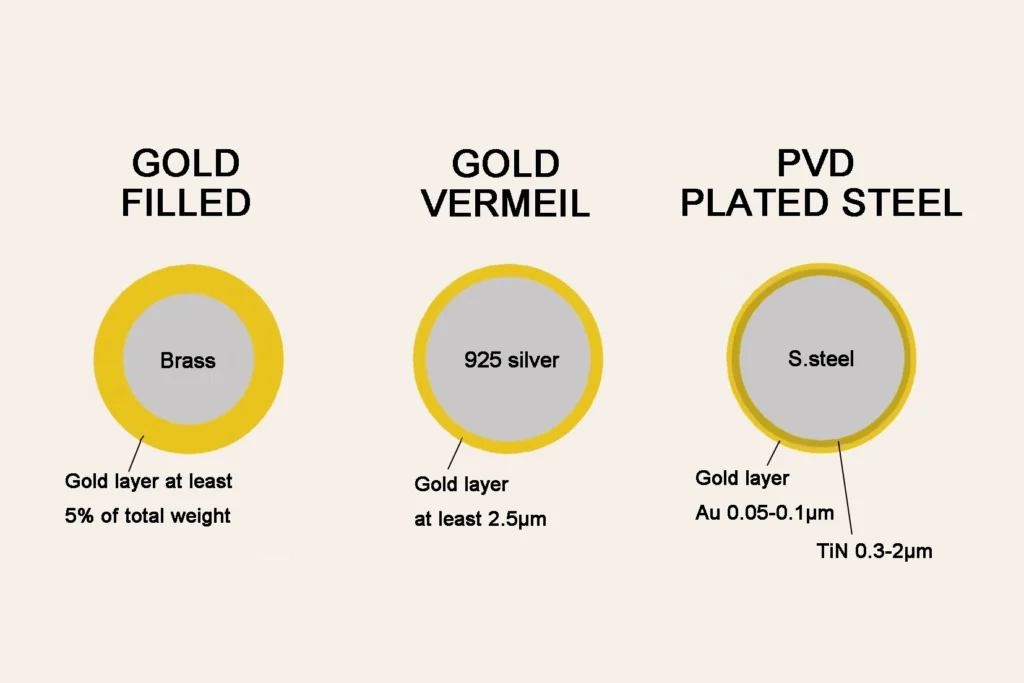
Base Metal: Brass.
Gold Layer: Thick layer of real gold (at least 5% of total weight), pressure bonded.
Durability: Very durable, resistant to tarnishing and wear.
Price: Mid-range. More affordable than solid gold, more expensive than plating.
Marking: Often marked as “14K GF” or “1/20 14K GF”.
Gold Vermeil
Base Metal: Sterling Silver (925).
Gold Layer: Electroplated with at least 2.5 microns of gold (usually 14K or higher).
Durability: Better than regular plating, but can wear off over time.
Price: Higher, due to silver base and thicker plating.
Marking: May be labeled as “925” or “Vermeil”.
PVD Plated Stainless Steel
Base Metal: Stainless Steel (commonly 304 or 316L).
Gold Layer: Ultra-thin layer (0.05–0.3 microns) applied via Physical Vapor Deposition (not electroplating).
Durability: Extremely high—resistant to scratches, fading, and corrosion.
Price: Lower cost, ideal for mass production.
Marking: Often described as “PVD Coated” or “Stainless Steel”.
Quick Comparison

Want to explore pieces made with each technique? Browse our collection or contact us for custom options.